Skip to content

QBCC 1199847/Family owned, made in Cairns

(07) 4057 5443/0456 622 443

Cairns, QLD

Security Doors in Freshwater

Colour, finish and range chosen against the house you already have, made to measure in Cairns, and repaired on site when the hardware gives out.

A security door in Freshwater answers to two views: yours from inside, and the street's view of your house. Cairns Security Doors makes doors and window screens to measure, manufactures them in Cairns, and repairs the ones already on the house. The second view is not only taste here. Freshwater is Neighbourhood character area 6 under CairnsPlan 2016, one of twelve in the whole region, and Cairns Regional Council has written down what the area looks like: inter-war, post-war and contemporary houses, predominantly low-set and high-set Queenslanders, in a range of light pastel colours. Tell us which openings you want done and we will measure them against the house you have.

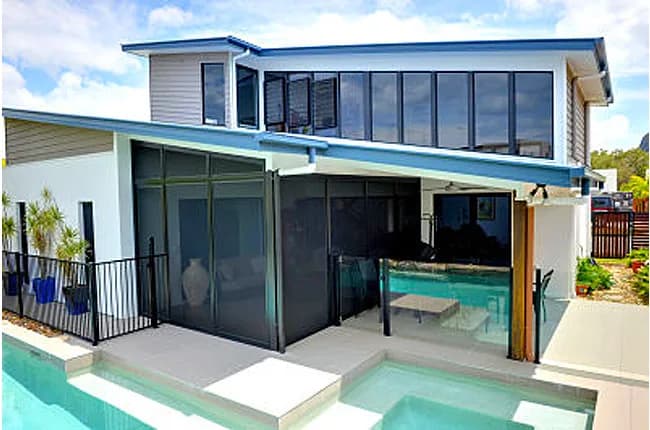
Two storey modern home with security screens enclosing the poolside patio

Cairns Regional Council keeps a written record of what this area looks like, and it is worth reading before anything is chosen. The character statement calls Freshwater a treed neighbourhood of undulating topography, established tropical gardens and a surrounding mountainous outlook, with narrow road pavements, grassy verges and informal street trees. The elements table under it names the building materials: timber, fibro sheet, render, brick, corrugated steel roofs, and a range of light pastel colours used in buildings. That record exists because Freshwater is Neighbourhood character area 6 under CairnsPlan 2016 Version 3.1, one of only twelve mapped across the Cairns region. Where the overlay applies, council weighs materials, finishes and colours, and whether a patio, verandah, balcony or understorey enclosure stays subservient to the building or conceals it when viewed from the street. A choice normally filed under taste is, here, something the planning scheme has an opinion about. Cairns Security Doors makes security doors and window screens to measure, manufactured in Cairns, and repairs the ones already fitted. What follows is what council records about this area, where a screen in an existing opening stops and enclosing a verandah starts, and how colour, finish and range actually get decided at the measure.

Why security doors matters in Freshwater

Walk your own street before you settle on a colour. Cairns Regional Council's record of this area names the materials already in front of you: timber, fibro sheet, render, brick and corrugated steel roofs, with a range of light pastel colours used in buildings, across a mix of inter-war, post-war and contemporary development. That is a description of a street you can go and check, which turns a powder coat from a last question after the money is agreed into a specification decision made at the quote.

Freshwater is small, and it is seen close up. The locality covers 1.74313 square kilometres on the Queensland locality boundary, and thirty-four named roads sit inside it, from Corkill Street to Old Smithfield Road, with Kamerunga Road the only one classified above Local. Council describes narrow road pavements, grassy verges and informal street trees, front setbacks generally 2 to 8 metres, and lot frontages commonly about 12, 18 or 20 metres. A house here is read from a footpath a few metres away rather than glimpsed at speed from a through road.

That is the setting the planning scheme responds to. Freshwater is Neighbourhood character area 6 under CairnsPlan 2016 Version 3.1, one of twelve mapped across the region. Where the overlay applies, the code asks that development incorporate materials, finishes and colours consistent with the existing buildings and be sympathetic to and not obtrusive in the streetscape, and for that outcome it supplies no acceptable outcome at all: there is no dimension to comply with, only a judgement about the result. It also asks whether patios, verandahs, balconies and understorey enclosures stay subservient to the building or conceal it when viewed from the street.

None of that means a screen needs approval. What it does mean is that the objection this business answers on its own product pages has two halves here. The business words the first half itself, that a screen spoils the view. The second half is what the street sees of the house, and council has already written down what the street looks like. Choosing between SCREENGUARD stainless on frames finished in Queensland in a variety of colours, Colonial Casting in a modern or heritage style, PERFGUARD at about 40 percent view through and Diamond Grille is how both halves get settled, against a house that already exists rather than against a catalogue.

You cannot tell from a brochure what a screen will look like on a Freshwater house.

Cairns Regional Council has already published what this area is made of. Its character statement for Neighbourhood character area 6 describes a treed neighbourhood of undulating topography, established tropical gardens and a surrounding mountainous outlook, with narrow road pavements, grassy verges and informal street trees. The elements table names a mix of inter-war, post-war and contemporary development, timber, fibro sheet, render, brick and corrugated steel roofs, a range of light pastel colours used in buildings, mixed roof styles pitched gabled and hipped to the street, front setbacks generally 2 to 8 metres and lot frontages commonly about 12, 18 or 20 metres. The locality runs to 1.74313 square kilometres on the Queensland locality boundary, with thirty-four named roads inside it and Kamerunga Road the only one classified above Local. Short setbacks, narrow pavements and thirty-three local streets mean the front of a house is read from a few metres away rather than at speed. This is also a long-settled place: it was named as a bounded locality in 1980, reclassified from locality to suburb in 2002 and re-gazetted in 2014 as an administrative consequence of the council de-amalgamation, and it takes its name from Freshwater Creek, named because that creek was the first permanent stream of fresh water travellers met on the journey from Cairns to the foot of the range. A screen chosen off a photograph can land wrong in a way an owner cannot put a name to until it is up. We measure at the house, and colour, finish and range get decided there, against the walls, the roof and the frontage actually in front of us rather than off a catalogue.
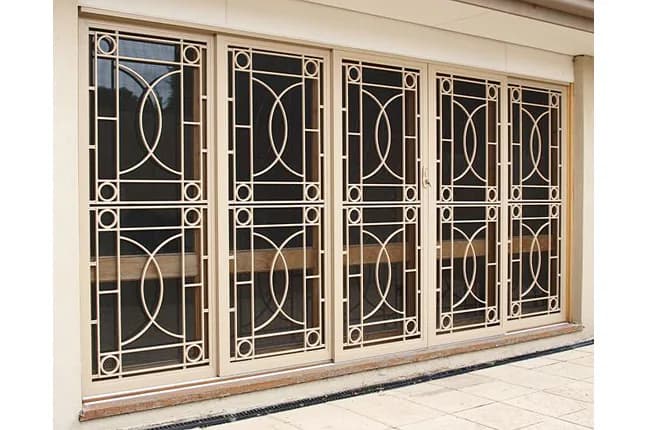
Five cream cast aluminium decorative security screens across a wide patio door opening

Where the overlay applies, materials, finishes and colours are judged, and there is no box to tick.

The neighbourhood character overlay code exists so that character places, streetscapes and areas are retained and protected, and so that development is consistent with, and complementary and responsive to, the distinctive character. Its outcome on materials asks for finishes and colours consistent with the existing buildings and structures on the place, and sympathetic to and not obtrusive in the streetscape, and the acceptable outcome under it reads that no acceptable outcomes are provided. A separate outcome asks that garages, carports, patios, verandahs, balconies, sheds and extensions stay subservient to the place, do not conceal a building on it and do not detract from the appearance of existing buildings when viewed from the streetscape. That is a judgement about the finished result rather than a dimension to comply with, which is the kind of question no product page answers. Council's own design guidance gets more concrete in one place that matters here: it illustrates a garage under a house closed with screen gates as a design solution consistent with local character, against a wide garage at the front with roller doors shown as inconsistent. Council is illustrating a design principle there rather than endorsing any product or supplier. Colour and finish get worked through at the measure against what is already on the house, because that is what the outcome is judged against. Colonial Casting comes in a modern style or a heritage style range for a decorative front door or to close in a patio, which makes it a fit decision rather than a decorative one.

Nobody tells you where a screen in an existing opening stops and building work starts.

Under CairnsPlan 2016, building work is accepted development unless the tables of assessment say otherwise, and accepted development does not require a development approval. The tables do vary that for a lot inside the neighbourhood character overlay, lifting building work on a site with an existing dwelling house to code assessable within one of two areas that Schedule 1 defines by a figure. Whether council treats fitting a screen into an existing opening as building work at all is a question for council, and no source read for this page settles it. The distinction that is supported is between orders of job. Putting a screen or a door into an opening the house already has, or repairing one that is on it, does not change the shape of the building or what it conceals from the street. Enclosing a verandah, a patio or an understorey does, and that is what the code's outcomes are written about. In an area where council records carports and garages often located under the dwelling, that second job is a common one rather than a hypothetical. We do not tell anyone they need approval for a screen, and we do not lodge planning applications. If you are weighing up closing in a verandah, patio or understorey, run your own address through Cairns Regional Council's CairnsPlan 2016 Property Report tool first, which council describes as an easy and convenient way to access planning scheme information relating to a specific property, including the applicable zones, local plans and overlays. Then tell us what you want quoted.

A flat mesh panel on a gabled timber frontage can look wrong in a way that is hard to name beforehand.

Council records the roof styles here as mixed, pitched and gabled and hipped to the street, skillion and flat, over a mix of inter-war, post-war and contemporary development. The ranges answer that differently. Colonial Casting is a cast panel security door available with a modern stylish look or as a heritage style range, sold for a decorative front door or to enclose a patio. SCREENGUARD is 316 stainless steel woven mesh in T6 grade high tensile extruded aluminium frames, manufactured and finished in Queensland in a variety of colours and marketed as designed to protect the view, with dynamic impact, knife shear, anti-jemmy, pull and probe testing recorded for the system. PERFGUARD is perforated aluminium at about 40 percent view through, powder coated black and described by its manufacturer as corrosion resistant. Diamond Grille is the cost effective option in the range. Front setbacks of 2 to 8 metres and lot frontages commonly about 12 metres put a front room close to a footpath, which makes privacy a practical question rather than a product feature. DVA one way vision mesh lets you see out with reduced visibility in, and it is a privacy mesh rather than a security product on its own, so it is combined with Diamond Grille or Colonial Casting. Pet mesh is thicker fibreglass with some give, for households with pets or high traffic areas. The black powder coat on PERFGUARD is a deliberate choice to talk through rather than a default, since council records light pastel colours as the prevailing local finish. The ranges go in front of you at the measure and get chosen against the house rather than against a photograph, and everything is made to that opening.

An inter-war opening, or one under a high-set house, was never a catalogue size.

Council records building height in this area as predominantly a mix of low-set and high-set Queenslanders, with carports and garages often located under the dwelling, across inter-war, post-war and contemporary development. Openings on that stock are frequently not standard sizes, and an under-house opening is not a stock size at all. Everything this business makes is made to measure rather than supplied in stock sizes, and it is manufactured in Cairns. It is also why the quote happens at the property. There is no showroom or workshop for a customer to visit and no counter to call in at, so the specification is taken on site. The fixing matters as much as the panel: the current Australian Standards for security door and window screens are AS 5039.1:2023 for classification and performance, AS 5039.2:2024 for installation and AS 5039.3:2023 for methods of test, and installation carrying its own current standard is the point, because a screen is only as good as the way it is fixed to the building. Cairns sits in wind region C under AS/NZS 1170.2 on Queensland Government and Cyclone Testing Station guidance, where the design wind speed is derived from tropical cyclones. We measure on site and make to that measurement rather than trimming a stock panel to fit. Ask for the manufacturer's current test certificate for whichever product you are considering and we will pass it on.

On an established Queenslander, a screen that has stopped working is not automatically one that has to be made again.

The Galvanizers Association of Australia, an industry association rather than a regulator, sets the general principle out in three parts: atmospheric corrosion cannot begin at all without an electrolyte present; how long a surface then holds water, time-of-wetness in the association's own term, governs how quickly it goes, with dew, rain and high humidity each adding to that time, and with the orientation of a surface and any crevice or lap able to hold water creating the conditions for corrosion in one spot rather than evenly across a panel; and micro-environments decide the local answer, since building density, vegetation and topography raise or lower corrosivity through sheltering effects. It is that third part council has already described here, in its own terms: a landscape character defined by undulating topography, with dense vegetation that generally dominates the streetscapes. Rain is not the scarce ingredient, since the Cairns airport station records 2,025.5 mm in an average year across 119.6 days on which at least a millimetre fell. What changes from one opening to the next is how much of it ever lands there. In an area council describes as a treed neighbourhood, with front gardens of dense tropical foliage, large palms and canopy trees, and with carports and garages often located under the dwelling, the openings that stay damp longest are the sheltered ones: under a deep eave, behind heavy planting, or down in an understorey. A sliding door track and a lock body are exactly the water-holding crevices the association names. What follows is the list of faults the business puts in its own words: a door not locking or closing properly, a broken handle, a jamming key, and sliding doors that roll incorrectly, jam, bounce, fail to close or jump off the track. None of it is a reason to replace a screen. The parts that hold a door shut and the parts that let it move are what gets changed at the house: a cylinder on its own or the whole lock, the wheels and the track under a slider, and the closers, hinges, patio bolts and triple locks around them, and a pet door can be fitted to a door the house already has. Work of that kind on a screen the opening already holds changes nothing about how the house reads from the street. The part an owner controls is washing, and it is a warranty term rather than a suggestion: the SCREENGUARD manufacturer's warranty runs 10 years subject to regular maintenance with SCREENGUARD Powawash, and PERFGUARD carries 7 years from date of installation, conditions apply.

SCREENGUARD 316 Stainless Steel Mesh Screens

316 stainless steel woven mesh set in T6 grade high tensile extruded aluminium frames, manufactured and finished in Queensland in a variety of colours. The manufacturer markets the system as designed to protect the view and records dynamic impact, knife shear, anti-jemmy, pull and probe testing for it. The load-bearing detail on a Freshwater house is not the weave, it is the finish: these frames are manufactured and finished in Queensland in a variety of colours. Council records a range of light pastel colours used in buildings across this character area, so the powder coat is chosen against your walls and roof at the measure rather than defaulted.

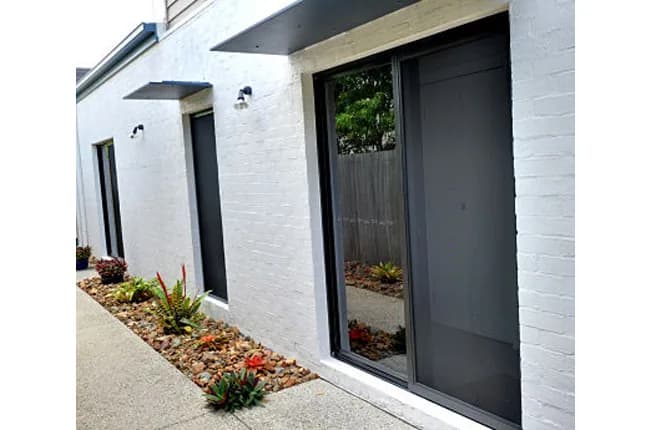
Dark security screens on the sliding door and windows of a white painted brick home with a tropical garden bed

PERFGUARD Perforated Aluminium Screens

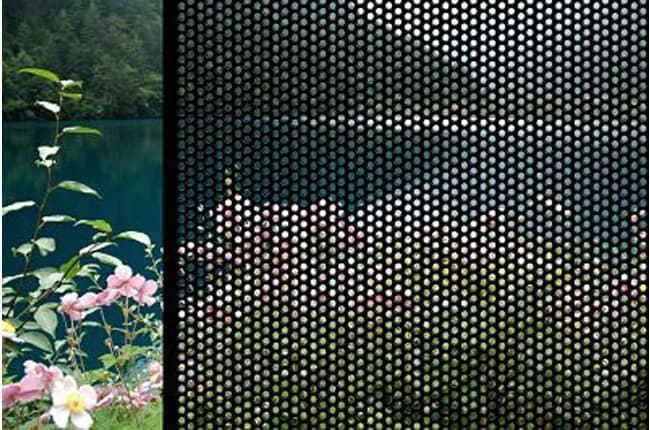
Perforated aluminium mesh, powder coated black, at about 40 percent view through and described by the manufacturer as corrosion resistant. Used on security doors, windows and patio enclosures, and for privacy or sun screening. The manufacturer records window grilles and hinged and sliding doors passing dynamic impact, pull, jemmy, knife shear and probe testing, with the doors tested using three point locking hardware. About 40 percent view through is the privacy answer for a front room set 2 to 8 metres back from a narrow pavement, which is what council records for this area. Corrosion resistant is the manufacturer's own description of the product. The black powder coat is a deliberate choice to talk through here rather than a default, given the light pastel palette council describes.

Side by side comparison of a garden view seen directly and through black perforated aluminium screen mesh

Diamond Grille Security Screens

The cost effective option in the range, with fibreglass mesh as standard behind it, made to measure like everything else. The cost effective option, and the one that turns a whole-house job into a decision per opening rather than a single front door decision. It also takes DVA one way vision mesh behind it where a street-facing room wants privacy as well, though DVA is a privacy mesh rather than a security product on its own.

Colonial Casting Security Doors

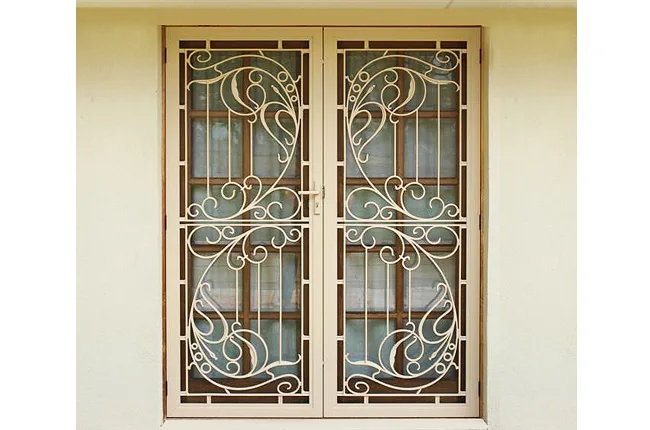
Security doors in a modern style or a heritage style range, for a decorative front door or to enclose a patio. This is the range that answers the appearance question head on. Council records the local stock as inter-war, post-war and contemporary development with roofs pitched, gabled and hipped to the street, and a cast panel door in a heritage style can sit on that kind of frontage where a flat panel does not. It is also the range sold for enclosing a patio.

Pair of cream decorative cast security screen doors with a scroll pattern over timber windows

Flyscreens and Specialty Mesh

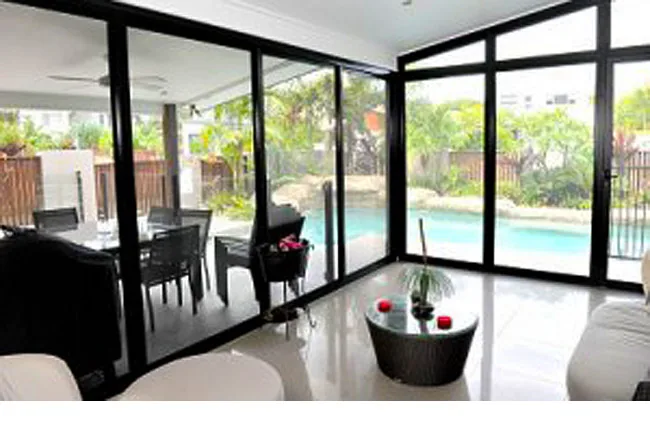
Fibreglass flyscreen mesh, described as not rusting, rotting or corroding, plus DVA one way vision privacy mesh, 316 stainless woven mesh, perforated aluminium, and pet mesh, which is thicker fibreglass with some give for households with pets or high traffic areas. Cairns Regional Council tells residents to install insect screens so the breeze can enter without the bugs, and records prevailing north and north-easterly breezes through the summer wet season with south and south-easterly trade winds year round. That makes which elevation to screen first a question with an answer rather than a guess. The fibreglass mesh is the one described as not rusting, rotting or corroding, and pet mesh is the thicker version with some give.

Open plan living room looking through black-framed security screen doors to a pool and palms

Onsite Repairs and Hardware Replacement

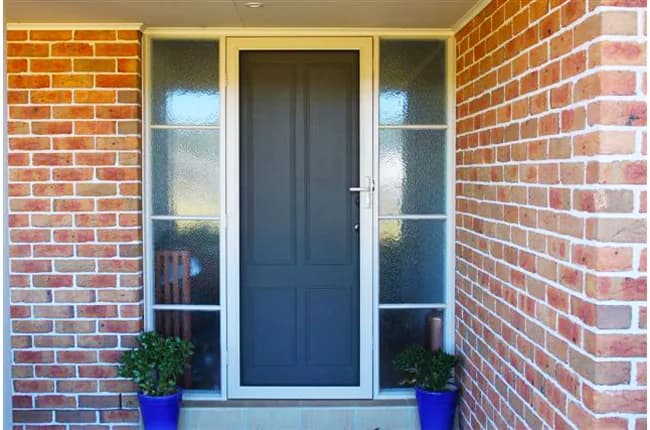
Onsite repair of security doors and screens: lock cylinders and complete locks, wheels and tracks on sliding doors, door closers, hinges, triple locks and patio bolts, and pet doors fitted to doors already on the house. The openings that need this first are the sheltered ones: under a deep eave, behind heavy front-garden planting, or down in an understorey, where a track or a lock body is still holding water long after the exposed openings have dried. Replacing hardware or mesh on a screen already sitting in an existing opening is a different order of job from enclosing anything.

Hinged security screen door fitted over a grey front door on a brick home entry
Licensed, tested, locally made

Credentials you can check

On a page carrying this much council material, it is worth marking out which facts belong to the business. The licence is the one a reader can take away and check: the business states QBCC 1199847 on its own site. Behind that number is a sole trader rather than a company, and the operation is family owned and operated. The making happens in Cairns, and each door and screen is built to the opening it is going into rather than picked from a set of stock sizes, which is why the specification gets taken at the house. Two subjects on this page are worth keeping apart. The neighbourhood character overlay is a planning matter about how development reads from the street. The Australian Standards for security door and window screens are AS 5039.1:2023, AS 5039.2:2024 and AS 5039.3:2023, and Part 1 is concerned primarily with resistance to forced entry.

QBCC Licensed Contractor
Queensland Building and Construction Commission licence 1199847
Verify this
Tested Security Screens
SCREENGUARD states its stainless steel mesh screens pass dynamic impact, knife shear, anti-jemmy, and pull and probe testing. PERFGUARD adds a probe test, with hinged and sliding doors tested using three point locking hardware.
10 Year Manufacturer's Warranty
SCREENGUARD products carry a full 10 year manufacturer's warranty. Regular maintenance with SCREENGUARD Powawash is required to comply.
Locally Made
Family owned and operated. Doors and screens are made to measure and manufactured in Cairns; SCREENGUARD frames are manufactured and finished in Queensland.

Questions we get asked

What does the neighbourhood character overlay actually look at?

Where it applies, the code names both the thing and the vantage point. A Neighbourhood character place is a lot inside a character area, taking in the buildings, structures and other improvements on it and any vegetation on the adjoining road reserve fronting it, and a Neighbourhood character streetscape is the streets and public places that place can be viewed from. So the appearance outcomes are about how development reads from a public street, which is why colour, finish and the way an enclosure sits on a building get weighed.

Do I need council approval for a security door on an existing opening?

That is not a question a screen maker can answer for you. Two separate things decide it, in this order: whether the lot is mapped in the overlay at all, and whether council counts the work you are planning as building work. The starting position under CairnsPlan 2016 is that building work is accepted development, and accepted development carries no development approval, but the tables of assessment vary that for a lot inside the overlay. So check the address first, then put the job itself to council.

How do I check whether the character overlay covers my address?

Use Cairns Regional Council's CairnsPlan 2016 Property Report tool. Council describes it as an easy and convenient way to access planning scheme information relating to a specific property, returning a summary of the applicable zones, local plans and overlays along with the mapping, and it is device responsive, so it works from a phone. That is the reliable answer, because a suburb name on a map sheet does not tell you what covers your lot.

We want to close in the understorey. Is that a different job?

Yes, and it is worth treating as one. Council records that carports and garages here are often located under the dwelling, and the overlay code carries an outcome for enclosing an understorey: it should preserve the dominant visual form of the upper storey and not detract from the overall character. Council's own design guidance shows a garage under closed with screen gates as consistent with local character, against a wide garage at the front with roller doors as inconsistent. Check your address first.

Council records light pastel colours here. What powder coat suits my house?

That gets decided at the measure, against your walls, your roof and your frontage. Council's record for this area names timber, fibro sheet, render, brick and corrugated steel roofs with a range of light pastel colours used in buildings, and describes those elements as guidance rather than a complete list. SCREENGUARD frames are manufactured and finished in Queensland in a variety of colours, so the finish is a specification choice rather than a stock one.

Why does the screen under the deep eave look worse than the one out in the weather?

Because it stays wet longest. The Galvanizers Association of Australia, an industry association rather than a regulator, describes the mechanism: corrosion needs an electrolyte, and the longer a surface stays wet the more quickly it corrodes, with crevices and laps that hold water causing localised corrosion, and with vegetation, topography and building density changing corrosivity through sheltering. The Cairns airport station records 2,025.5 mm of rain a year across about 120 rain days. Deep eaves, dense front-garden foliage and an understorey are where a screen dries slowest.

Wet season breezes come from the north and north-east. Which openings do we screen first?

Council's design guide for tropical homes records prevailing north and north-easterly breezes through the summer wet season and south and south-easterly trade winds year round, and tells residents to install insect screens so the breeze can enter without the bugs, because air movement is essential to staying cool and to reducing the effects of high humidity. So the openings on those elevations are usually where a staged job starts, and we work that out at the measure.

What is the difference between stainless steel mesh and Diamond Grille?

Stainless steel mesh is finely woven, so it keeps a clear view out through it. Diamond Grille uses a visible diamond pattern and is the more cost effective of the two. Both are security products and both are made to measure for the opening. The choice comes down to how much view you want against what you want to spend, and we can show you both at the measure.

Are your security doors made to measure?

Yes. Every door and screen is made to measure rather than bought off the shelf, and it is manufactured here in Cairns. SCREENGUARD aluminium frames use T6 grade high tensile extruded aluminium, manufactured and finished in Queensland in a range of colours. Get in touch to arrange a measure for your doors or windows.

What is one way vision mesh?

DVA one way vision mesh lets you see out while reducing visibility into your house from outside. It is a privacy mesh rather than a security product on its own, so it is usually combined with a Diamond Grille or Colonial Casting security screen when you want privacy and security in the same door or window.

Can you repair my existing security door?

Yes, and we repair onsite. The common jobs are replacing a lock cylinder or the complete lock when a door will not close properly or the key jams, and replacing the wheels or track work on sliding doors that bounce, jam, or jump off the track. We also replace door closers, hinges, triple locks and patio bolts.

Which Cairns suburbs do you service?

We service Cairns and the surrounding areas. That covers the northern beaches from Machans Beach up to Palm Cove, the northern suburbs around Smithfield, Redlynch and Freshwater, the Cairns city suburbs, and the southside through to Gordonvale. Check our service areas page for the full list of suburbs, or call us to confirm your street.

Need security doors in Freshwater?

Two things, in this order. If you are weighing up closing in a verandah, a patio or an understorey, put your own address through Cairns Regional Council's CairnsPlan 2016 Property Report tool first: council describes it as an easy and convenient way to get the planning scheme zones, local plans and overlays that apply to a specific property, and it is device responsive, so it works from a phone. Then tell us which openings you want done, because an inter-war opening or one under a high-set house is specified on site rather than over the phone. We come to the property to measure, and there is no showroom or workshop to visit. Colour, finish and range get chosen there, against the walls and the roof you already have. One last thing. A key that has stopped turning cleanly, a broken handle and a slider that bounces instead of closing are all hardware faults, and hardware gets replaced at the house rather than the whole screen.