Security screens, airflow and heat: what changes in a tropical house
Updated
The short answer
Yes, every security screen takes some of the breeze, because wire or metal fills part of the opening. How much depends on the infill. In the makers' own tests, woven wire security mesh passes between 41 and 53 percent of airflow and one perforated aluminium screen passes 40 percent, while a standard fibreglass flyscreen is 63 percent open by area. On heat, a screen fixed outside the glass works as shade: makers report a window's energy efficiency improved by up to 53 percent and 62 percent of UV filtered.
8 sections, a comparison table and 6 questions, about 11 minutes
This guide sets those published figures side by side and explains why they aren't measured the same way. It then covers what a screen means for a Cairns house that runs on open doors and ceiling fans, including what to weigh up before leaving a door open at night behind a locked screen.
Openness and airflow: two different numbers behind the breeze
Two kinds of number get quoted for how much air a screen lets through, and they measure different things.
Openness is geometry: the share of the mesh area that's hole rather than wire or yarn. Alspec lists its standard 18 by 14 strand fibreglass flyscreen mesh at 63% openness.
Airflow is a test result. Amplimesh says air infiltration tests show the effective openness of its SupaScreen stainless security mesh at 41% of air flow. Crimsafe tested its 0.9 mm Tensile Tuff security mesh in a custom designed wind tunnel and reports that it allows, on average, 53% airflow.
One figure is an area and the others are lab results from different rigs, so 63 against 41 isn't a fair contest. Use each number to compare products measured the same way: Alspec meshes against each other, or one maker's security infills against each other. The honest summary is that any screen takes a real share of the breeze, and the infill decides how big that share is.
Woven stainless, perforated aluminium, grille and fibreglass compared
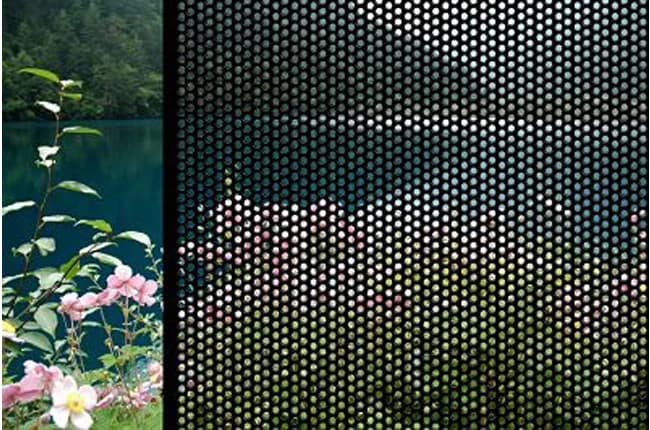
Woven stainless and perforated aluminium security screens come out almost level in the one maker's test that covers both. Amplimesh's air infiltration figures give 41% for its SupaScreen stainless steel mesh and 40% for its IntrudaGuard perforated aluminium. Its PrivacyGuard screen is far lower at 10.8%. Solid area that blocks sight lines blocks air as well.
Fibreglass varies more than people expect. Alspec lists its UltraVue fibreglass at 73% open, its standard mesh at 63%, its Sandfly mesh at 45% and its PetScreen pet mesh at 36%. Finer or tougher insect mesh costs openness.
A grille door has two layers. In the Diamond Grille and Colonial Casting doors we make, fibreglass sits behind the grille or cast panel, so air passes the grille and then the fibreglass. We haven't found a published airflow figure for that pair, or for the SCREENGUARD 316 stainless and PERFGUARD perforated aluminium we fit, so the table marks those gaps rather than guessing.
Published airflow, openness and heat figures by infill (each maker's own measure)
Infill
Published figure
What was measured
Notes
Woven stainless, SupaScreen (Amplimesh)
41% of air flow
Air infiltration test, maker's figure
Stainless steel security mesh
Woven wire, Tensile Tuff 0.9 mm (Crimsafe)
53% airflow on average; 62% of UV filtered
Wind tunnel test; UV light test, maker's figures
Window energy efficiency up to 53% better under WERS
Invisi-Gard security screens
Up to 51% better window energy efficiency
WERS rating with the screen fixed outside the glass
No airflow figure in our sources
Perforated aluminium, IntrudaGuard (Amplimesh)
40% of air flow
Air infiltration test, maker's figure
Perforated aluminium security screen
Privacy screen, PrivacyGuard (Amplimesh)
10.8% of air flow
Air infiltration test, maker's figure
Shows the airflow cost of a privacy infill
Standard fibreglass, 18 by 14 strands (Alspec)
63% openness
Open share of the mesh area
Area figure, not an airflow test
UltraVue, Sandfly and PetScreen (Alspec)
73%, 45% and 36% openness
Open share of the mesh area
Finer or tougher insect mesh is less open
SCREENGUARD 316 stainless (what we fit)
Not published in our sources
Not published in our sources
View through stays clear
PERFGUARD 2 mm perforated aluminium (what we fit)
About 40 percent view through
View through, not airflow
Listed for privacy and sun screening
Diamond Grille with fibreglass behind
Not published in our sources
Not published in our sources
Air passes the grille and then the fibreglass
Published airflow, openness and heat figures by infill (each maker's own measure)
Woven stainless, SupaScreen (Amplimesh)
Published figure41% of air flow
What was measuredAir infiltration test, maker's figure
NotesStainless steel security mesh
Woven wire, Tensile Tuff 0.9 mm (Crimsafe)
Published figure53% airflow on average; 62% of UV filtered
What was measuredWind tunnel test; UV light test, maker's figures
NotesWindow energy efficiency up to 53% better under WERS
Invisi-Gard security screens
Published figureUp to 51% better window energy efficiency
What was measuredWERS rating with the screen fixed outside the glass
NotesNo airflow figure in our sources
Perforated aluminium, IntrudaGuard (Amplimesh)
Published figure40% of air flow
What was measuredAir infiltration test, maker's figure
NotesPerforated aluminium security screen
Privacy screen, PrivacyGuard (Amplimesh)
Published figure10.8% of air flow
What was measuredAir infiltration test, maker's figure
NotesShows the airflow cost of a privacy infill
Standard fibreglass, 18 by 14 strands (Alspec)
Published figure63% openness
What was measuredOpen share of the mesh area
NotesArea figure, not an airflow test
UltraVue, Sandfly and PetScreen (Alspec)
Published figure73%, 45% and 36% openness
What was measuredOpen share of the mesh area
NotesFiner or tougher insect mesh is less open
SCREENGUARD 316 stainless (what we fit)
Published figureNot published in our sources
What was measuredNot published in our sources
NotesView through stays clear
PERFGUARD 2 mm perforated aluminium (what we fit)
Published figureAbout 40 percent view through
What was measuredView through, not airflow
NotesListed for privacy and sun screening
Diamond Grille with fibreglass behind
Published figureNot published in our sources
What was measuredNot published in our sources
NotesAir passes the grille and then the fibreglass
Heat and UV: a screen works by shading the glass
A security screen cuts heat by shading the glass, so the tested benefit is on windows the sun hits. Your Home, the Australian Government's guide to sustainable houses, says glazing is the main source of heat gain in a home.
Crimsafe reports that its screens improved a window's energy efficiency by up to 53% under the Window Energy Rating Scheme (WERS), taking a 3 mm single glazed window from zero stars to a 3 star cooling rating. Invisi-Gard reports up to 51% for its screens fitted over the outside of a window. On UV, Crimsafe says its mesh filtered 62% of UV radiation, and that the thicker the wire, the less UV gets through the holes.
Read the conditions behind those figures. Invisi-Gard notes that WERS screen ratings apply to a screen permanently fixed on the outside of the window and covering the entire glass area. A hinged door you swing open every morning isn't shading anything while it's open.
Light and the view out: denser infill means a darker room
The more solid the infill, the less daylight reaches the room, so a security screen dims a room according to how much metal it puts across the glass. Crimsafe says its mesh is black because black absorbs light and is non-reflective, so what you see through it is light that came straight through the holes. It also says that, depending on the angle of the sun, the mesh acts as a very effective blind while keeping the view.
Among the meshes we fit, the spread is wide. SCREENGUARD 316 stainless is woven tightly enough that the view through it stays clear. PERFGUARD is a 2 mm aluminium sheet, powder coated black and perforated to about 40 percent view through, and it reads noticeably darker than woven stainless. That's why we list PERFGUARD for privacy screening and sun screening as well as security. Our range of mesh page covers what each one is for. For daytime privacy without the darker sheet, our guide to one way vision mesh explains how DVA works and where it stops.
Open doors on a hot night, with the screen locked
If you're thinking of leaving a glass door open overnight for the breeze, the screen across it becomes the barrier, so the kind of screen matters. The National Security Screen Association (NSSA) describes a security screen as a physical barrier to entry that allows airflow while keeping insects and intruders out, and says it must pass strict testing to the Australian Standard and carry a compliance label. A flyscreen door doesn't do that job.
Cairns nights are warm enough to want the air. Bureau of Meteorology figures for Cairns Aero put the mean minimum temperature at 23.8°C in January and February, and mean 9am humidity at 72% across the year. Your Home's advice for hot humid summers and warm winters is that even homes with air conditioning should be designed for sleeping comfort without it, so it can be switched off at night.
Lock the screen, though. Queensland Police advise keeping external doors and screens to balconies locked when the place is unoccupied or at night, and say many high-rise break-ins happen through open or unlocked balcony doors. The same notice also says to ensure all windows and doors in the home are locked, so an open glass door behind a locked screen is a trade off you weigh for your own home.
Getting the breeze through the house: openings and fans
The screen is one part of the breeze path, and where the openings sit matters as much as the mesh. Your Home says air movement needs well designed openings and unrestricted breeze paths. Cairns Aero's mean 3pm wind speed is 18 km/h against 12.5 km/h at 9am, so the afternoon reading is the breezier of the two. Run these checks on your own house:
Open on two sides. Amplimesh's cooling advice is to open doors or windows at the front and back so air circulates through the house, which it calls natural cross flow ventilation.
Make the downwind opening bigger. Your Home says to use larger openings on the leeward (downwind) side and smaller ones on the windward side to draw the breeze through.
Count the part that opens. Your Home notes that sliding and double hung windows limit how much of the window can be opened, and a screen only ever sees the open part.
Stop internal doors blocking the path. Your Home suggests a louvre or awning window above internal doors so breezes pass through while keeping privacy and security.
Run the ceiling fans. Your Home says low fan speeds work well in high humidity: 0.5 metres per second at 50% relative humidity cuts the perceived temperature by 3°C. energy.gov.au adds that a fan has to blow on you to work and costs around 2 cents an hour to run.
Choosing for the rooms that need breeze: start with the use of each opening
Pick the infill opening by opening, starting from what each room needs most: breeze, view, shade or privacy.
For bedrooms and living areas you keep open for the breeze, woven security mesh is the usual fit. It keeps the view clear, and in the makers' published tests woven security meshes pass between 41 and 53 percent of airflow. SCREENGUARD 316 marine grade stainless is the mesh we use for that job.
For an east or west facing window that heats the room, Your Home calls adjustable vertical shading such as external blinds the optimum solution for those walls, and in hot humid climates it advises shading every external opening, south facing ones included. A perforated sheet like PERFGUARD trades some view and light for shade and privacy on those openings.
Where cost decides it, Diamond Grille is the cost effective option, and its airflow then depends on the fibreglass behind it. Our comparison of diamond grille and stainless steel mesh goes through view, strength and care between the two.
Before you order: insects, labels and a quote
Two checks sit alongside airflow. If biting midges come in at night, the hole size of the mesh matters as much as the breeze, and our guide to screens for midges and mosquitoes covers that trade. If an existing screen is meant to be your night time security, look for the compliance label: the NSSA says a product has to pass Australian Standard testing and carry the label to be called a security screen.
Fitting is a job for the installer. The NSSA notes that security screen installers need to be licensed in many states, and a security screen relies on how it's fixed as much as on the mesh.
Every door and screen we make is made to measure and manufactured in Cairns, across the security doors and screens range. Tell us which rooms you open up and which way they face when you ask us for a quote, and we can talk through the infill for each opening.
Questions we get asked
Do security screens cut the breeze?
Yes, partly, because any infill puts metal or yarn across the opening. Amplimesh's air infiltration tests put its stainless SupaScreen at 41% of air flow and its perforated IntrudaGuard at 40%. Crimsafe reports that its woven Tensile Tuff mesh allows 53% airflow on average in its wind tunnel test. Opening doors or windows on two sides of the house helps the breeze that does get through keep moving.
Do security screens keep heat out?
They can cut the sun's heat through a window when fixed over the outside of the glass. Crimsafe reports up to 53% better window energy efficiency under WERS, and Invisi-Gard up to 51%, both for screens fitted over the outside of a window. Invisi-Gard notes that WERS screen ratings only apply to screens permanently fixed outside and covering all the glass. A door screen swung open shades nothing, so external blinds still earn their place on sunny walls.
Which security mesh lets the most air through?
In the published tests we found, woven stainless and perforated aluminium are close. Amplimesh measured 41% for its stainless SupaScreen and 40% for its perforated IntrudaGuard, and Crimsafe reports 53% for its woven wire mesh in a different test. Privacy infills sit far lower, with Amplimesh's PrivacyGuard at 10.8%. Only compare figures from the same test, and ask any supplier for theirs.
Do security screens block UV?
Some, and the maker's own figure is the fair guide. Crimsafe says its Tensile Tuff security mesh filtered 62% of UV radiation in its UV light test, and that thicker wire lets less UV through the holes. We haven't found a published UV figure for SCREENGUARD or PERFGUARD, so if UV is your main reason for buying, ask the supplier for a tested figure in writing.
Can I leave my doors open overnight with a security screen?
That's your call to weigh up, and it only makes sense with a tested security screen that's locked. The NSSA says a security screen must pass testing to the Australian Standard and carry a compliance label, which a flyscreen door doesn't have. Queensland Police advise keeping external doors and screens to balconies locked at night and whenever the place is empty. Check older screens for the label, and lock the screen rather than leaving it on the latch.
Which screen suits a Cairns house that relies on breeze?
Usually woven security mesh on the openings you keep open, since it keeps the view clear and passes 41 to 53 percent airflow in makers' tests. Bureau of Meteorology figures put Cairns Aero's January mean minimum at 23.8°C, so the night breeze matters. Perforated aluminium suits sunny east or west openings where shade and privacy count for more. We make every screen to measure in Cairns, so the mesh can change room by room.
Where this comes from
The published sources this guide draws on, and the date each one was checked.