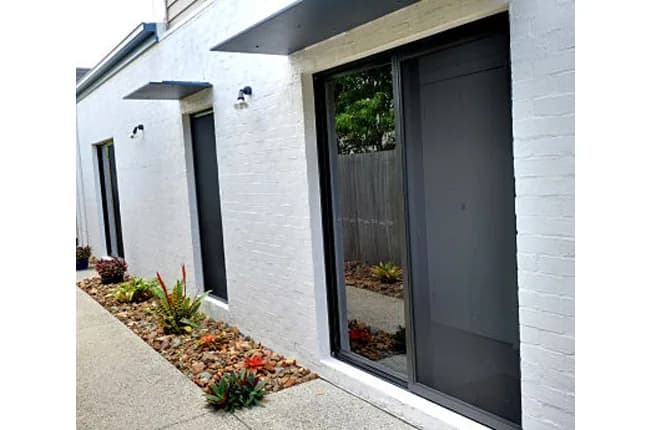
Security screen door hinges: sagging, dragging and replacement
Updated
The short answer
A hinged security door that drags on the ground has usually dropped at the lock side, and the cause sits somewhere on the hinge side: screws that have worked loose, hinges that have worn, or the frame they're fixed to moving. The National Security Screen Association (NSSA) says a security door should hang on fixed-pin hinges.
8 sections, a comparison table and 5 questions, about 9 minutes
This guide explains what makes security door hinges different, the signs a door has dropped, how to tell which of the three causes you're looking at, why the screw matters near the sea, and where an owner check ends and a repair begins.
The short answer: a dragging security door has dropped out of its clearances
A security door that scrapes the floor or the sill has moved from the position it was fitted in. In its fitting instructions for the Elegance XC hinged door lock, Austral Lock asks owners to check once a year that the door operates with the correct clearances and opens and closes without obstruction, and to adjust the door if necessary. A scrape on the ground is the plainest sign those clearances have gone.
The drop usually shows up in more than one place. The door that scrapes at the bottom often catches at the lock too, because the latch no longer lines up with the strike plate. That's why dragging and lock trouble can arrive together.
Don't keep forcing a dragging door shut, since every scrape wears the door and whatever it rubs on. Work out which part has moved first, using the checks below, then decide whether it's a screwdriver job or a repair job.
Security door hinges are fixed-pin, and that changes the fix
A security door's hinges should be fixed-pin, so the pin can't be pulled out. The NSSA says a security door should have at least three fixed-pin hinges, ideally recessed or with hinge fillings to prevent tampering or jimmying.
Two things follow for an owner. First, any fix that starts with knocking out a hinge pin doesn't apply. A fixed-pin hinge isn't meant to come apart, so leave the pins alone. Second, swapping a worn hinge for whatever fits the screw holes can quietly give away the very feature that stops someone lifting the door off from outside.
So on a security door, adjusting the hang usually means tightening, packing or replacing hinges as a matched set, not reshaping a single pin.
Signs a security door has dropped
A dropped security door rarely announces itself with one symptom. Look for two or three of these together, then check the hinge side before blaming the lock or the closer. Close the door slowly by hand and watch it the whole way, rather than letting the closer pull it shut.
The gap is a useful clue. On Austral Lock's Elegance XC hinged door lock, a door that won't lock or won't stay closed means the trigger bolt isn't being pressed as the door shuts, and the fix is a gap between door and strike plate of no more than 3 mm, made by packing the hinges or the strike plate. A door that has dropped or swung away from the frame can open that gap up. Austral Lock's Elegance XC manual also says malfunctions of that lock are usually the result of incorrect installation.
A fresh scrape or shiny wear line on the sill, tiles or decking under the door.
The gap around the door is wide at the top on the lock side and tight at the bottom.
The door has to be lifted or pushed before it latches.
The lock turns easily with the door open but fights you with it shut.
On a triple lock, the top or bottom bolt hits the frame beside its keeper.
The closer pulls the door most of the way, then it stalls or bounces back.
Loose screws, worn hinges or a moving frame: watch where the movement is
To tell the three causes apart, stand on the hinge side, take hold of the door near the lock and lift it gently while someone watches each hinge. Where something moves tells you which cause you're dealing with. The table below sets out what each pattern points to and the check that's safe to try yourself.
Loose screws are the one fault an owner can often fix. If a screw turns and bites, a firm snug is all it needs. If a screw spins without tightening, the hole has stripped and a longer screw or a new fixing point is needed, which is fitting work.
A worn hinge shows as play inside the hinge itself while the screws stay still. A moving frame shows as the whole hinge jamb shifting, or cracks in render, timber or sealant around it. Neither is fixed by tightening screws. The NSSA notes that compliant security screen doors are made and installed to very tight tolerances with specialised fixings.
Telling loose screws, worn hinges and a moving frame apart on a hinged security door
What moves when you lift the lock side
Likely cause
Safe owner check
Where it becomes a repair
Screw heads rock or sit proud of the hinge leaf
Loose fixing screws
Snug each screw firmly by hand
A screw spins without biting
Play inside the hinge knuckle, screws stay still
Worn hinge
Note which hinge moves and photograph it
Any worn hinge on a security door
The whole hinge jamb shifts or the sealant cracks
Frame or fixing into the wall moving
Look for cracks around the frame
Always: the frame needs refixing
Corrosion around a screw head
Corroding fixing, possibly mixed metals
Wash the hinge side with fresh water
Crumbling screws or stained aluminium
Nothing moves, but the door still scrapes
Hang or packing out from new, or a closer forcing it
Unhook the closer and swing the door by hand
The door binds with the closer off
Telling loose screws, worn hinges and a moving frame apart on a hinged security door
Screw heads rock or sit proud of the hinge leaf
Likely causeLoose fixing screws
Safe owner checkSnug each screw firmly by hand
Where it becomes a repairA screw spins without biting
Play inside the hinge knuckle, screws stay still
Likely causeWorn hinge
Safe owner checkNote which hinge moves and photograph it
Where it becomes a repairAny worn hinge on a security door
The whole hinge jamb shifts or the sealant cracks
Likely causeFrame or fixing into the wall moving
Safe owner checkLook for cracks around the frame
Where it becomes a repairAlways: the frame needs refixing
Safe owner checkWash the hinge side with fresh water
Where it becomes a repairCrumbling screws or stained aluminium
Nothing moves, but the door still scrapes
Likely causeHang or packing out from new, or a closer forcing it
Safe owner checkUnhook the closer and swing the door by hand
Where it becomes a repairThe door binds with the closer off
Screws and salt: why the wrong fixing fails near the sea
Near the coast, where a screw and a security door hinge are different metals, the join can corrode faster than the rest of the door. The Australian Stainless Steel Development Association (ASSDA) says galvanic corrosion needs three conditions: a join wet with a conductive liquid, metal-to-metal contact, and metals with sufficiently different potentials. It adds that salt significantly increases the conductivity of water, so galvanic effects are normally more severe near the coast.
That matters for a hinge, where the screw, the hinge leaf and the frame can each be a different metal. ASSDA says aluminium fasteners in stainless steel are not acceptable, and that a stainless screw in aluminium is frequently used, although the aluminium immediately around it may corrode. Galvanised fasteners in stainless steel also lose their zinc faster than they would on their own.
ASSDA's answer is isolation. Suitable plastic strips, washers or sleeves stop galvanic corrosion, while paint is not a reliable insulator under bolt heads, nuts or washers. A hinge screw that's visibly corroding is a sign to get the fixing replaced properly.
Replacing security door hinges: match the set, not just the size
Replacing security door hinges like for like means matching what the door was built with, not just what fits the holes. The checklist below covers what to look at before a hinge is swapped. Treat it as the questions to ask, since fitting new hinges on a security door is a job for a repairer.
The NSSA also says a compliant security door almost always has a 3-point lock that secures it at the top, middle and bottom. New hinges that sit the door even slightly higher or lower move all three bolts relative to their keepers, so a hinge change should finish with the lock checked at every point.
Count the hinges. The NSSA's guidance is at least three on a security door.
Keep fixed pins. A replacement should be a fixed-pin hinge, not a lift-off one.
Keep any recessing or hinge fillings the original set had.
Ask what the screws are made of and whether the join is isolated in salt air.
Replace worn hinges as a set so the door hangs evenly.
Lubricate the new hinges as the hardware maker directs.
Check the lock catches cleanly with the door shut, not only with it open.
Upkeep that keeps hinges from dropping the door
Hinge upkeep on a security door is mostly washing and the right lubricant. SCREENGUARD, the stainless mesh range we build in, says to lubricate the locks and hinges as the hardware manufacturer directs. For aluminium doors and windows more generally, A&L Windows says the operational life of its products is increased if light machine oil is applied to moving parts and hinges, so check your hardware maker's own advice before choosing a product.
The closer is worth checking at the same time. Lockwood's instructions for its 404 hydraulic screen door closer say the door must close freely before the closer goes on. If a door only shuts when the closer drags it, check the hang first, because turning up the closer can mask a hinge fault.
Washing matters for the fixings as much as the mesh. Salt on a hinge leaf keeps the join wet, which is the first of ASSDA's three conditions for galvanic corrosion. Our cleaning guide covers a coastal routine.
When a dragging security door is a repair job
A dragging security door becomes a repair job as soon as tightening a plainly loose screw doesn't put it right. Packing hinges, replacing a hinge set, re-drilling stripped fixings and straightening a door that has dropped are fitting work. In Queensland, the QBCC lists fabricating and installing security screens and doors within the scope of its glass, glazing and aluminium licence class, and the NSSA recommends installation by a member rather than DIY.
The NSSA's warning is worth keeping in mind. A screen can be made to operate without providing proper security, so a door that swings again after a quick fix isn't proof it's secure. Don't drill new holes, swap in lift-off hinges or remove hinge pins to make it close.
We repair security doors onsite, including replacing hinges, door closers, triple locks and patio bolts, and our doors are made to measure in Cairns if a frame is past saving. See what a visit covers on our onsite repairs page, or check the areas we serve.
Questions we get asked
Why is my security door dragging on the ground?
Usually because the door has dropped at the lock side. The cause usually sits on the hinge side: screws that have loosened, hinges that have worn, or the frame they're fixed to moving. Lift the lock side gently while someone watches each hinge to see which part moves. Tighten any screw that's plainly loose. If the door still scrapes after that, packing or replacing hinges is a job for a repairer.
Can I replace security door hinges with standard hinges?
It isn't a good idea. The National Security Screen Association says a security door should have at least three fixed-pin hinges, ideally recessed or with hinge fillings to stop tampering. A hinge with a removable pin gives away the very feature that's meant to stop tampering. Ask for fixed-pin replacements that match the original set, fitted with screws suited to the frame metal.
How many hinges should a security door have?
At least three, according to the National Security Screen Association, and they should be fixed-pin hinges, ideally recessed or with hinge fillings to prevent tampering or jimmying. If your security door hangs on two hinges, or one has been swapped for a lift-off type, mention it when you book a repair, because it affects both how the door hangs and how well it resists being forced.
Can a dropped security door still lock properly?
Often not reliably. On Austral Lock's Elegance XC, a door that won't lock or stay closed means the trigger bolt isn't being pressed as it shuts, and the fix is a door to strike plate gap of no more than 3 mm, made by packing the hinges or strike plate. A dropped door can also move the top and bottom bolts of a triple lock away from their keepers.
Do you replace security door hinges in Cairns?
Yes. We repair security doors onsite around Cairns, including replacing hinges, door closers, triple locks and patio bolts. When you book, tell us where the door scrapes and what moves when you lift the lock side, and send a photo of the hinges if you can. If the frame is past repair, our doors are made to measure and manufactured in Cairns.
Where this comes from
The published sources this guide draws on, and the date each one was checked.