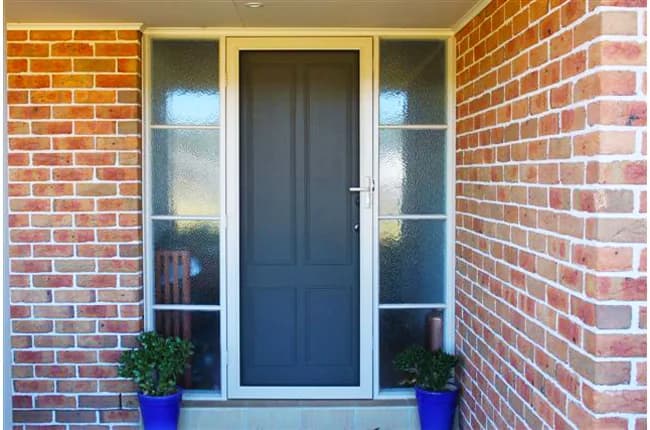
Security door installation: fixings, frames and what to check
Updated
The short answer
A security door is installed properly when its frame is fixed firmly into sound material, it hangs square so it opens and closes without forcing, and its lock catches at every point once the door is shut. The National Security Screen Association (NSSA) says installing to the security screen installation standard is just as important as the security door itself.
7 sections, a comparison table and 6 questions, about 10 minutes
This guide is a buyer's check, not a set of fitting instructions. It covers what changes when the frame goes into brick, timber or an existing aluminium frame, why the screws matter near the sea, what a square hang does for the lock, the mistakes worth looking for, and a checklist for the day the door goes in.
A security door is only as strong as what holds it to the house. The NSSA says screens installed to the installation standard are designed to withstand knife shear, jemmy, probe, corrosion, pull and impact tests. So the result you're paying for depends on the fixing as well as the mesh, frame and lock.
The NSSA also says compliant security screen doors are made and installed to very tight tolerances with specialised fixings. Its warning is blunt: you may be able to put a screen up and make it operate, and the product may still not provide proper security. From the footpath, a door fitted well and a door fitted badly look much the same.
One thing you can see is the compliance label. The NSSA says security doors must be supplied and installed with one, and that if a door isn't labelled, it isn't a security door. Our guide on whether security screens stop burglars covers what a tested, locked screen does and doesn't do.
Brick, timber or aluminium: the fixing changes with the frame
How a security door frame is fixed depends on what it's going into. The national unit of competency for screen installers, published on training.gov.au, covers installing on surfaces including aluminium, concrete, masonry, steel and timber. It has the installer identify the product, its measurements and its fasteners, working from the work order and the supplier's instructions.
Brick needs its own approach. Ramset, which makes masonry anchors, says anchoring into bricks and blocks needs a different approach from anchoring into solid concrete. Its guide says the anchor must firmly clamp the fixture to the face of the brick without splitting it or causing other damage, and that an anchor's capacity is frequently limited by the strength of the brick itself.
Position matters too. Ramset says anchors should ideally sit in the centre of the brick or block, and in hollow units such as wire cut bricks and concrete blocks, in the solid section, though it adds that this isn't always practical. The table below sets out what each surface asks of the fixing, and the question worth putting to your installer.
What a security door fixing has to do in each kind of opening, and what to ask
What the frame is fixed into
What the fixing has to do
Question to ask the installer
Solid brick
Clamp the frame firmly to the face of the brick without splitting it, ideally near the centre of the brick
What anchor are you using, and where in each brick will it sit?
Hollow or cored brick and block
Find the solid section of the unit where it can, since the brick's own strength often limits the anchor
How will the fixings hold if they land over a core?
Timber jamb
Fix into a jamb that has been checked first and adjusted if needed
Is the jamb sound enough to fix to, or does it need work first?
Existing aluminium frame
Avoid a metal pairing that corrodes in salt air, or keep the metals apart
What are the screws made of, and is anything isolating them from the frame?
What a security door fixing has to do in each kind of opening, and what to ask
Solid brick
What the fixing has to doClamp the frame firmly to the face of the brick without splitting it, ideally near the centre of the brick
Question to ask the installerWhat anchor are you using, and where in each brick will it sit?
Hollow or cored brick and block
What the fixing has to doFind the solid section of the unit where it can, since the brick's own strength often limits the anchor
Question to ask the installerHow will the fixings hold if they land over a core?
Timber jamb
What the fixing has to doFix into a jamb that has been checked first and adjusted if needed
Question to ask the installerIs the jamb sound enough to fix to, or does it need work first?
Existing aluminium frame
What the fixing has to doAvoid a metal pairing that corrodes in salt air, or keep the metals apart
Question to ask the installerWhat are the screws made of, and is anything isolating them from the frame?
Near the sea, the screws need matching metals
In a coastal house, the screws holding a security door should be chosen for salt air as much as for strength. The Queensland Reconstruction Authority's cyclone resilient building guidance says that if your home is near saltwater, fasteners and connectors should have a higher corrosion resistance than normal.
Mixed metals are the second risk. The Australian Stainless Steel Development Association (ASSDA) explains that salt significantly increases the conductivity of water, so galvanic corrosion between different metals is normally more severe near the coast. It says aluminium fasteners in stainless steel are not acceptable, while a stainless screw in aluminium is frequently used even though the aluminium right around it may corrode.
ASSDA's answer is separation. Suitable plastic strips, washers or sleeves between the two metals stop galvanic corrosion, it says, and paint isn't a reliable insulator under bolt heads, nuts or washers. So ask what each fixing is made of, what it's going into, and whether anything keeps the two apart. Our guide to 316 and 304 stainless mesh covers mesh grades for the same salt air.
Square, plumb and packed: a door that hangs true locks properly
A properly fitted security door frame sits level across the head and sill and plumb up the sides. The earlier national competency unit for installing security screens, since superseded by the current one, set that out as the outcome: the jambs assessed and adjusted as needed, then the frame positioned and secured so the head or sill is level and the stiles plumb.
The hang shows up in the lock. Austral Lock's instructions for its Elegance XC hinged security door lock say that after installation the door should be correctly adjusted with the correct clearances, and the lock should engage the strike plate correctly. If that lock won't lock or won't stay shut, the same instructions say to bring the gap between door and strike plate to no more than 3 mm by packing the hinges or the strike plate.
On a triple lock that alignment has to hold three times over. The NSSA says a compliant door almost always has a 3-point lock securing it at the top, middle and bottom, so each bolt has to meet its keeper. Our triple lock guide explains how those locks work.
Common installation mistakes to look for
Many installation faults show up as a door that needs help to close or lock. Austral Lock says malfunctions of its Elegance XC lock are usually the result of incorrect installation. Its first test is simple: operate the lock with the door open, and if it works correctly then, there's a fitting problem rather than a faulty lock.
These are the signs worth looking for on a newly fitted door. None of them needs a tool to spot, and each one is a reason to ask the installer back while the job is still fresh.
No compliance label anywhere on the door.
Fewer than three hinges, or hinges whose pins lift out. The NSSA says a security door should have at least three fixed-pin hinges.
A lock that turns freely with the door open but is stiff, or won't throw, with it shut.
A latch that only catches when you push or lift the door.
A top or bottom bolt on a triple lock that hits the frame beside its keeper.
Screws that spin, sit proud, or have cracked the brick or split the timber around them.
Screws or a lock that has scratched or chipped the finish around it.
Stainless and aluminium touching with nothing between them on a house near the sea.
A handover checklist for the day it is fitted
Run through these checks before the installer packs up, while fixing a fault is still part of the same visit. The current national competency unit for screen installers includes testing the installed screen for correct operation, adjusting it where needed, and advising the customer on correct operation and maintenance. Asking to see each point is a reasonable request.
Keep the checklist for later, too. Austral Lock asks owners of its Elegance XC lock to inspect the door every year to confirm it still operates with the correct clearances and opens and closes without obstruction, and to adjust it if necessary. The same checks on handover day give you a baseline to compare against.
Find the compliance label and take a photo of it.
Open and close the door slowly by hand. It should swing without rubbing on the frame, sill or floor.
Look down both sides and across the top. The gap between door and frame should look even.
Shut the door and lock it with the key. Every bolt should throw without you pushing on the door.
Open the lock from inside and outside, and check every key you've been given.
Look at each fixing point for cracked brick, split timber or a chipped finish.
Ask what the fixings are made of, and whether different metals are kept apart.
Ask how the door and lock should be cared for, and keep the warranty paperwork.
Leave the fitting to a licensed installer
Fitting the door is the installer's job, not the owner's. In Queensland, the QBCC lists fabricating and installing security screens and doors in the scope of work for its glass, glazing and aluminium licence. The NSSA's advice to buyers is not to DIY, and to use one of its members.
That sets the line for an owner. Looking, operating the door and lock, photographing the label and asking questions are all fine. Drilling new holes, changing anchors, packing hinges or re-fixing a frame that has moved belong to the installer or a repairer. If something on the checklist fails after the installer has gone, call them back rather than adjusting it yourself. If the door drops or drags later on, our security door hinges guide explains the likely causes.
How is a security door attached to a brick opening?
With anchors or masonry screws drilled into the brick and chosen to suit it. Ramset, a masonry anchor maker, says brick needs a different approach from solid concrete: the anchor has to clamp the frame firmly to the face of the brick without splitting it, ideally in the centre of the brick, and in the solid section of a hollow brick or block. Ask your installer which fixing they use and where it sits.
What should I check when the door is fitted?
Start with the compliance label, then work the door. It should open and close by hand without rubbing, and the key should throw the lock at every point without you pushing on the door. Look at each fixing for cracked brick, split timber or chipped finish, and ask what the screws are made of. The national installer competency unit includes advising customers on operation and maintenance, so ask.
Does a badly fitted security door still count as tested?
Not with any confidence. The NSSA says screens installed to the installation standard are designed to withstand knife shear, jemmy, probe, corrosion, pull and impact tests, and that installing to that standard is just as important as the door itself. It also warns that a screen can be put up and made to operate without providing proper security. A tested door relies on a sound fit.
Is it difficult to install a security door yourself?
It isn't a job the industry recommends for homeowners. The NSSA advises against DIY because compliant doors are made and installed to very tight tolerances with specialised fixings. In Queensland, fabricating and installing security screens and doors falls within the QBCC glass, glazing and aluminium licence. Measuring an opening to compare quotes is a reasonable owner job; drilling, anchoring and hanging the door are not.
How can I tell where a security door is catching?
Close it slowly by hand and watch the gap around the frame for the point where it rubs or tightens. Then try the lock with the door open. Austral Lock's instructions say that if its lock works correctly with the door open, the problem is in the fitting rather than the lock. A latch that misses the strike plate, or a bolt that hits beside its keeper, points to the hang.
Who installs security doors in Cairns?
We do. We're a family owned, QBCC licensed business that measures each opening on site, makes the door to measure in Cairns and comes back to fit it, with no showroom in between. We also repair locks, wheels, tracks and pet doors on existing security doors. Check the areas we serve for the suburbs we cover, or request a quote to book a measure.
Where this comes from
The published sources this guide draws on, and the date each one was checked.
There is no single best security screen in Cairns. Choose by salt exposure and by opening, then check the label, test report, lock, warranty and QBCC licence.
7 sections, a comparison table and 6 questions, about 11 minutes