Heritage and decorative security doors for character homes
Updated
The short answer
A heritage or decorative security door is a security door with a patterned infill, usually a cast panel or a grille, in place of a plain mesh. For a character home, choose the pattern that suits the house, confirm that exact product carries a security door label, and have fibreglass mesh fitted behind the panel. On our decorative doors, the cast panel or grille does the security work and the fibreglass behind it keeps the insects out.
9 sections, a comparison table and 6 questions, about 10 minutes
This guide compares a cast panel, a diamond grille and woven stainless on an older Cairns home, including where each one falls short. It also covers pattern families, salt air care, colour, what sets the price, and where to check council's character rules.
The short answer: choose the pattern, then check the label
Style and security are two separate questions, and a door can pass the first and fail the second. You'll see a decorative door every time you walk up the front steps, so the style deserves real thought, but it tells you nothing about what the door is made to stop.
The National Security Screen Association (NSSA) says the term security door can only be used if the door can be shown to meet the Australian Standards. Its test for buyers is blunt: if the door isn't labelled, it isn't a security door. The NSSA adds that a barrier or safety door does not meet the same safety and performance testing and standards.
So on a heritage entry, work through the questions in order. Which pattern suits the house? Is that exact product tested and labelled? What sits behind the panel for insects? How will the finish cope with salt air? And does your address sit in a character area?
Common decorative patterns: scroll, filigree, geometric and arched
The Colonial Casting catalogue plates we choose designs from fall into a handful of families:
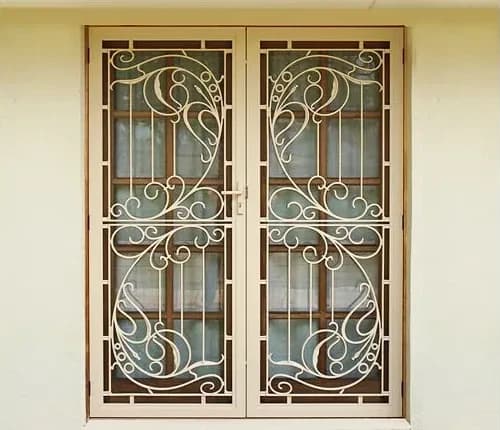
Scroll patterns, with curling motifs across the panel.
Lattice and filigree patterns.
Geometric designs, some of them arched at the top.
Panels with a mid-rail motif, a band of detail across the middle of the door.
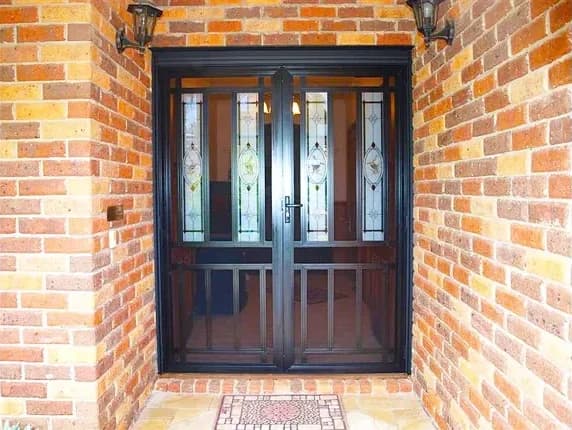
Doors with leadlight glass panels set into the design.
Designs sized for sliding door openings, so a patio slider can match the front door.
What a decorative panel does, and what sits behind it
A decorative panel is the security layer, and the mesh behind it does a different job. In a Colonial Casting door, the cast panel at the front carries the security work. The fibreglass mesh fitted behind it, standard on our cast and grille screens, is there to keep insects out. On its own, that fibreglass would only be an insect screen.
The Australian Standard for security screens shows why the second layer is needed. It sorts infills by the size of their gaps. Woven wire mesh and perforated sheet are small aperture, where nothing thicker than a 3 mm probe gets through. Diamond screens are medium aperture and must stop an arm. Cast panels are one of the standard's examples of large aperture, which only has to stop a body.
That class says nothing about insects, which is where the fibreglass comes in. It won't rust, rot or corrode. For privacy as well, DVA one way vision mesh can be paired with a Colonial Casting panel. We fit DVA combined with a Colonial Casting panel rather than on its own, so the panel still does the security.
Cast panel, grille or stainless mesh: look, view and limits
A cast panel gives the most decorative look and woven stainless gives the clearest view, so the choice turns on whether you want the door to be seen or to fade back. A diamond grille sits between them.
Colonial Casting is our decorative range, with cast panels in modern and heritage designs for a front entry or to close in a patio. Its limit: of the three, a cast panel sits in the largest aperture class in the standard, so the fibreglass behind it is essential, and the pattern stays in your outlook every time you look out.
Diamond Grille is the cost effective option in our range, a visible diamond pattern rather than a fine mesh. Its limits are that the diamond is a geometric pattern rather than a period motif, and like a cast panel it needs fibreglass behind it for insects.
SCREENGUARD is the stainless mesh system we make our stainless doors with. Its owner, Darley Aluminium, supplies the system to security fabricators rather than selling it flat packed, and we measure, make and fit the door. It's the woven 316 marine grade stainless people choose when keeping the view matters, and SCREENGUARD states its hinged doors keep views, natural light and fresh airflow without compromising security or insect protection. Its limits are that there's no decorative pattern to echo period detail, and SCREENGUARD makes its warranty conditional on a care schedule, covered in the salt air section below.
PERFGUARD perforated mesh is another range we build with.
The NSSA lists decorative steel, aluminium grille, perforated aluminium sheet and stainless steel mesh as security door infills. Every door we make is built to measure, so a cast front door with stainless on the back slider is a fair way to split the house.
Cast panel, diamond grille and woven stainless on a character home, factor by factor
Factor
Cast panel (Colonial Casting)
Diamond Grille
Woven 316 stainless (SCREENGUARD)
Look
Cast pattern, modern or heritage
Geometric diamond pattern
Fine weave that keeps the outlook
Gap class in the standard
Large: must stop a body
Medium: must stop an arm
Small: stops a 3 mm probe
Insect layer
Fibreglass behind the casting
Fibreglass behind the grille
The mesh itself, per SCREENGUARD
Main limit
Largest aperture class of the three
No period motif
No decorative pattern
Salt air check
Ask which casting alloy
Ask for the finish care terms
Wash every 2 weeks within 5 km of the coast
Cast panel, diamond grille and woven stainless on a character home, factor by factor
Look
Cast panel (Colonial Casting)Cast pattern, modern or heritage
Diamond GrilleGeometric diamond pattern
Woven 316 stainless (SCREENGUARD)Fine weave that keeps the outlook
Gap class in the standard
Cast panel (Colonial Casting)Large: must stop a body
Diamond GrilleMedium: must stop an arm
Woven 316 stainless (SCREENGUARD)Small: stops a 3 mm probe
Insect layer
Cast panel (Colonial Casting)Fibreglass behind the casting
Diamond GrilleFibreglass behind the grille
Woven 316 stainless (SCREENGUARD)The mesh itself, per SCREENGUARD
Main limit
Cast panel (Colonial Casting)Largest aperture class of the three
Cast panel (Colonial Casting)Ask which casting alloy
Diamond GrilleAsk for the finish care terms
Woven 316 stainless (SCREENGUARD)Wash every 2 weeks within 5 km of the coast
Matching the door to the house: proportion and colour
A door matches the house most easily when it's chosen standing in front of the house, which is why colour, finish and range get decided at the measure, against your walls, roof and frontage rather than a catalogue page.
Start with proportion. Openings in older Cairns houses are rarely square. That's why each of our doors is measured on site and made to that exact opening, rather than trimmed down from a stock size.
Then colour. SCREENGUARD states its frames are powder coated in Dulux and Interpon colours. For Colonial Casting and Diamond Grille, the colour is chosen at the measure against your trim. Settle it before the door is made, and ask how a later repaint would affect the finish and warranty.
Salt air and upkeep: ask about the alloy, then wash on a schedule
A decorative door near the sea lasts better when the materials suit the setting and the finish is washed on a schedule. The Australian Standard for security screens notes that some aluminium casting alloys have only moderate corrosion resistance, and should be used only after weighing the application and the environment. So the alloy question is worth asking before you buy.
For stainless doors, SCREENGUARD sets the schedule. It states its 10 year warranty runs from installation provided its care and maintenance schedule has been kept, and that regular maintenance with SCREENGUARD PowaWash is required to comply. In its severe or coastal band, 5 km from coastal or marine areas, that means maintenance every 2 weeks. For stainless, the Australian Stainless Steel Development Association (ASSDA) notes that sheltered spots rain doesn't wash are particularly susceptible to tea staining.
For powder coated cast panels and grilles, A&L Windows, a window and door maker, gives cleaning guidance for its own powder coated aluminium. It isn't written for security doors, but it's a useful comparison. A short owner checklist:
Ask which alloy the panel is cast from and what finish is on it, and get the care and warranty terms in writing.
Near the water, ask about the fixings: where different metals meet, they need to be compatible or kept apart.
On powder coat, A&L Windows suggests warm water and a non-abrasive, pH neutral detergent on a soft cloth, sponge or soft brush, then a good rinse, and no solvents, caustic or abrasive cleaners.
A&L Windows also suggests the sprinkle setting on the hose, aimed downwards, rather than a strong jet.
On stainless, SCREENGUARD says to avoid abrasive pads, scourers and steel wool, and to keep the bottom track and drainage clear.
On stainless, give extra attention to doors under a deep verandah or behind heavy planting, where rain rarely washes the salt off.
If you're choosing stainless mesh within five kilometres of the surf, ASSDA's minimum is grade 316 or a grade with equivalent corrosion resistance.
A sagging door or a lock that won't catch is a repair job, not a cleaning one.
What sets the price of a decorative door
Every door is quoted after a measure at your property, because each one is made to that opening and there's no showroom or stock size to price from. Within our range, Diamond Grille is the cost effective option and Colonial Casting is the decorative one.
If you're weighing up a cast front door against a plainer one, ask for both in the same quote.
Character areas and council rules: check your address with council
Cairns Regional Council is the place to check whether character rules touch your house, and the answer depends on the exact property. Council maps neighbourhood character areas under CairnsPlan 2016. Freshwater, for example, is Neighbourhood character area 6, one of twelve across the region. Our Freshwater security doors page sets out what council has written about that area.
To see what applies to your own address, use council's CairnsPlan 2016 Property Report tool. It gives a summary of the zones, local plans and overlays that apply to a specific property, with maps. Council is clear that the report is for general reference only. It doesn't replace a Planning and Development Certificate or professional legal or town planning advice.
We don't tell anyone they need approval for a screen, and we don't lodge planning applications. If you're also thinking about closing in a verandah or patio, take that question to council before you book a measure.
Next step: book a measure and quote
To get a price for your entry, request a quote through the form on our contact page or give us a call, and we'll book a measure at your place.
At the measure, we'll go through colour, finish and range against what's already there, then measure the opening and make the door to that measurement in Cairns. Still weighing up a grille against stainless? Our guide to diamond grille and stainless steel mesh compares the two.
Keeping an old decorative door a while longer is an option too. We replace lock cylinders and complete locks, plus door closers, hinges, triple locks and patio bolts.
Questions we get asked
What patterns do decorative security doors come in?
In the Colonial Casting catalogue we choose designs from, the patterns run from scrolls and lattice or filigree to geometric and arched designs, panels with a mid-rail motif and doors with leadlight glass. The panel does the security work, and fibreglass mesh fitted behind it keeps insects out. Check the label on the exact product either way.
Are decorative security doors as secure as stainless mesh doors?
Both can be tested security doors, so check the label rather than judging by the pattern. They're tested to different gap sizes, though. A cast panel is classed to stop a person getting through, while woven mesh must stop a 3 mm probe. Ask for the compliance label for the exact door, and make sure it has a 3 point lock, which the NSSA treats as standard on a compliant security door.
Do decorative security doors keep insects out?
Only with a mesh fitted behind the panel. The Australian Standard classes cast panels as large aperture, which only has to stop a body, so it does nothing for insects. That's why our Colonial Casting and Diamond Grille screens come with fibreglass mesh behind them as standard. If you'd also like privacy, DVA one way vision mesh can pair with the casting, so talk through the insect side of that combination at the quote.
How much does a decorative security door cost?
We quote each door after measuring it at your property, because every one is made to measure for its opening and there's no stock size to price from. Diamond Grille is the cost effective option in our range and Colonial Casting is the decorative one, so ask for both in the same quote if you're deciding between them.
Can a security door be made to suit an old Queenslander entry?
Yes. Every door is made to measure and manufactured in Cairns, which helps on older houses where openings are rarely square. We measure on site and build to that opening instead of cutting down a stock size. For a period look, Colonial Casting comes in heritage designs as well as modern ones. Mention anything unusual about the entry when you book, so it's covered at the measure.
Do I need council approval for a security door in a character area?
We can't answer that for your property, so check with Cairns Regional Council. Its CairnsPlan 2016 Property Report tool lists the overlays on an address. Council says that report is a general guide and doesn't take the place of a Planning and Development Certificate or town planning advice. For a look at one character area in plain terms, see our Freshwater security doors page.
Where this comes from
The published sources this guide draws on, and the date each one was checked.